
Research question
Communication agencies sell a service that takes effect only at the receiver. Whether a campaign, a press text or a web presence has succeeded shows itself with the contractor’s customers and in the public. From this the study derives its key research question.
The key research question
Which quality factors in the agency produce communication success at the contractor, and how can they be arranged in a quality management model? This is how the problem statement of the first chapter can be summarized. It closes with a practical version of the same question, namely how the processes between agency, contractor, the contractor’s customers and the public can be improved and deepened.
A clarification of terms comes first. What quality means in communication is determined by the receiver. Good marketing communication gets the intended message across to the addressee. Which influencing factors determine this quality and what success means here had hardly been examined systematically before the study.
From the sender-receiver model to the network
The starting point is Schramm’s communication model. It describes communication through four elements: the sender, the receiver, the message and its transference. Later works added signs and symbols, the context of reception, the social shaping of the receivers and the cultural basis of understanding. The study transfers the model to communication with an economic intention.
As soon as an agency is involved, the line becomes a network with four parties. On behalf of a company, the agency sends messages to that company’s customers; the same messages reach the public. At the same time, the contractor speaks to its customers itself. Indirect image effects arise between customers and the public, and towards the contractor and the public the agency also promotes itself. In Schramm’s terms, the agency remains the sender and the contractor’s customers are the receivers. The agency sets the most important processes in this network in motion.
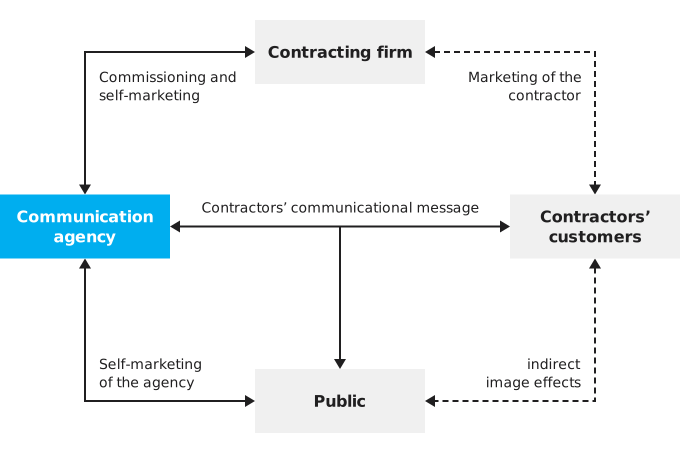
- Four parties: the communication agency, the contractor, the contractor’s customers and the public.
- Agency and contractor, solid double arrow: commissioning in one direction, the agency’s self-marketing in the other.
- Agency and the contractor’s customers, solid double arrow: the agency conveys the contractor’s message; a branch leads the same message to the public.
- Agency and public, solid double arrow: the agency’s self-marketing.
- Contractor and the contractor’s customers, dashed double arrow: the contractor’s marketing.
- The contractor’s customers and the public, dashed double arrow: indirect image effects.
- The agency is highlighted: as the sender, it sets the most important processes in motion.
Why quality management from manufacturing does not fit
Quality management originated in goods production, with the automotive industry as a pioneer. The concepts were transferred to services only later, prompted by the idea that the total value of a customer determines long-term market success. For communication services, the thesis names three obstacles.
- A final inspection does not work. With intangible services, quality cannot be tested on the finished product. Quality management has to cover every stage of value creation.
- Every service is a one-off. How a message works depends on the situation and the receiver. Customers’ expectations are therefore difficult to standardize.
- The media have changed. Electronic channels have shifted the rules of product communication. Standards from older forms no longer fit them.
Which of the known models can nevertheless serve as a basis is compared on the page ISO 9001, TQM and EFQM.
What the research covered
There are numerous studies on the quality of services, for example on service quality gaps according to Parasuraman, Zeithaml and Berry or on the effect of quality management (QM) systems in service companies. None of them deals with the communication business. Studies on the prerequisites of good communication each look at one segment: communication with customers, dialogue with suppliers or the processes within the company itself. An overall view of all relationships was lacking.
Communication success was measured mainly from the perspective of contractors or of marketing, through consumers’ attitudes, image, brand loyalty or stock returns. The agency as an intermediary did not feature in this. What remained open was which factors in the agency produce success with the customer. This gap is the subject of the study.
Four part questions
The key research question breaks down into four part questions. A literature review in three parts answers the first three, the empirical part with pre-test and survey the fourth.
| No. | Part question | Dealt with in | Answer of the study |
|---|---|---|---|
| 1 | Which existing QM models are suitable for examining professional communication processes? | Literature review part 1, 16 studies | ISO 9001 only partly suitable, Total Quality Management (TQM) more easily adaptable but without guardrails; the European Foundation for Quality Management (EFQM) model provides the best basis and is adapted |
| 2 | Which factors contribute to the quality of the communication processes of European agencies according to the literature? | Literature review part 2, 31 studies | Leadership efficiency, employee quality, communicational strategy, resource integration |
| 3 | With which parameters can communication success be measured, and how are they connected from sender to receiver? | Literature review part 3, 24 studies | Customer value, social value, financial value |
| 4 | How must communication processes be designed so that agencies achieve the best possible quality in practice? | Pre-test and survey of contractors | Leadership first, success shows in customer trust and reputation |
The basic assumption
The thesis rests on a causal chain. Certain characteristics of the agency, which the study calls communication enablers, determine the quality of the communication process. This quality shows itself as success at the contractor, for example in customer value, in image or in the loyalty of its customers. Experience of success flows back into the agency as learning.
Behind this stands a proposition about communication itself. The thesis understands it as a personal and, at its core, democratic process. Technology does not replace the relationship of trust between sender and receiver; quality arises from the sender’s commitment. The proposition is tested with the QMC model, the quality management model for the communication industry, and a survey whose design is described on the page Method. The results fit this. In the final model, the agency’s leadership comes first, and on the success side the trust of the customers.

QMC model
Unlike the EFQM, the model measures financial value directly and lists employees only as an enabler.
ISO 9001, TQM and EFQM
For none of the three models did the study find an application in the communication business.
Method
After the pre-test, 20 of the 26 measurement categories from the literature remained for the questionnaire.