
The development of a Quality Management Model for European Communication Agencies
Dr. Florian Bresler (2018): The development of a Quality Management Model for European Communication Agencies. Dissertation (Doctor of Business Administration, DBA), FHM Bielefeld, University of Gloucestershire & Cyprus International University.
The thesis develops a quality management model for communication agencies and tests it empirically. Translated loosely into German, the title reads “Die Entwicklung eines Qualitätsmanagement-Modells für europäische Kommunikationsagenturen”. It completed the doctorate; the academic degree is Doctor of Business Administration (DBA).
Fact sheet
| Feature | Detail |
|---|---|
| Title | The development of a Quality Management Model for European Communication Agencies |
| Author | Dr. Florian Bresler |
| Type | Dissertation, degree Doctor of Business Administration (DBA) |
| Language | German, with an English title |
| Scope | Introduction and five chapters, 29 figures, 10 tables, three study overviews in the appendix |
| Model | QMC model, quality management model for the communication industry |
| Method | systematic literature review, action research as a pre-test, survey of contractors, structural equation model |
| Data basis | 1,331 contractors addressed, 298 responses, 209 complete questionnaires |
| Keywords | Quality Management, Communication, Communication agencies, Communication processes, Strategy development |
Outline
- Introduction. Structure of the thesis, communication as a competitive factor, extended sender-receiver model with agency
- Chapter 1, State of research. Problem statement, scientific significance, four research questions
- Chapter 2, Literature Review. Quality and quality management; ISO 9001, Total Quality Management (TQM) and the European Foundation for Quality Management (EFQM) model; adaptation of the EFQM model to the communication business; the four communication enablers; measures of communication success
- Chapter 3, Conceptual model development and qualitative pre-test. Research paradigm, action research, hypotheses, structural equation analysis, ethical issues, validity and reliability
- Chapter 4, Analysis and Factual Evidence. Univariate analysis, testing of the hypotheses, critique of the initial model, three model amendments
- Chapter 5, Conclusions. Placing the study in the research, propositions, contribution to knowledge, validity and reliability, generalizability, personal development, professional practice, limitations, future research
- References and appendix. Overviews of 16 studies on quality management (QM) models, 31 studies on quality enablers and 24 studies on communication success
Summary
Communication agencies work in a network of the contractor, the contractor’s customers and the public, and in the end it is the receivers who judge the value of their work. Quality management originates in goods production. For agencies, whose services are intangible and whose effect depends on situation and receiver, a suitable model was lacking. There was also no study of which characteristics of an agency actually generate success at the contractor.
The thesis first compares ISO 9001, Total Quality Management and the EFQM model. The EFQM provides the best basis and is adapted for the industry. Two further literature reviews, on the prerequisites of good communication (31 studies) and on the measures of its success (24 studies), supply the building blocks of the QMC model. In it, four enablers of the agency, leadership efficiency, employee quality, communicational strategy and resource integration, act on a latent communication quality. The quality shows itself at the contractor as customer value, social value and financial value. A learning loop leads success back to the enablers.
In a pre-test, executives from two internationally active agencies rated 26 categories of the model. Six of these were discarded, and 20 indicators went into the questionnaire. The survey addressed 1,331 contractors with a completed order of more than €100,000. There were 298 responses, and 209 questionnaires were complete. The evaluation used a structural equation model.
The initial model held only in part. Four of seven core hypotheses were accepted, two of them being reference paths that are not tested individually. After three amendments, leadership efficiency in the final model is by far the strongest enabler, with a standardized weight of 0.98; resource integration dropped out (Results). On the success side, customer trust with 0.80 and reputation gains with 0.14 remain. According to these findings, agency work acts through the trust of the contractor’s customers and through the contractor’s reputation; no significant effect on stock value, return on equity and Tobin’s q could be demonstrated. The study did not examine whether trust pays off in the long term.
The thesis names its limitations itself. The model had to be reduced substantially, cross-relationships between the enablers are not estimated, and the respondents come from the customer circles of two agency networks.
Abstract
The communication of products, corporate competences and profiles has risen in importance due to the globalization and virtualization of markets. The impact of communication quality on communication success though has not been assessed systematically so far. The central idea of this study is to describe and quantify the causal relationships between enabling factors of professional communication processes and the success of commercial communication at all relevant levels. The Quality Management Model is verified conducting a survey among customers of European communication agencies and evaluating it in a structural equation model. The result is a communications industry specific causal model providing an overview on the impact of communication enablers on elements of communication success. It supports communication agencies in strategy development, eases adaptation to market needs and strengthens their position in an increasingly global competitive environment. Specifically, the study finds that in European Communication Agencies leadership efficiency is the key to communication quality and communication success. Rather than immediate financial effects, communication quality strengthens customer trust and effectuates reputation gains at the contractor. Agency work is a long-term project that stabilizes provider-customer relationships by work on image and loyalty.
Wording of the author’s English abstract of the dissertation. The reputation gain was measured at the contractor, and the initial model held only in part (Results).
Approach in three stages
The study combines a systematic literature review, a qualitative pre-test modelled on action research and a quantitative survey. Each stage builds on the result of the previous one. How the stages were designed in detail is described on the page Method.
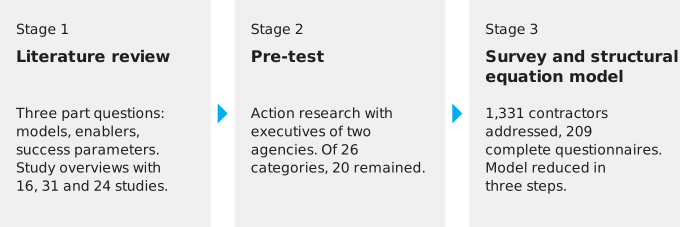
- Stage 1, literature review: three part questions on models, enablers and success parameters; overviews of 16, 31 and 24 studies.
- Stage 2, pre-test: action research with executives of two agencies; of 26 categories, 20 remained.
- Stage 3, survey and structural equation model: 1,331 contractors addressed, 209 complete questionnaires evaluated, the model reduced in three steps.
Papers from the doctorate
Two papers from the doctorate appeared in the Zeitschrift für interdisziplinäre ökonomische Forschung. The first prepares the literature part, the second reflects on the learning process during the doctorate.