
ISO 9001, TQM and EFQM in communication agencies
Whether the best-known models of quality management can be transferred to communication agencies is the first of the four part questions of the study. A search in four databases (Google Scholar, EBSCOhost with EconLit, Emerald Insight and Scirus) using English search terms on quality management in the communication business found no study that examines ISO 9001, Total Quality Management (TQM) or the European Foundation for Quality Management (EFQM) model in agencies. The search was therefore extended to service providers in marketing and public relations and screened manually. Appendix 1 of the thesis summarizes 16 studies. In it, three models prove relevant for service providers.
What quality management is meant to achieve
Quality management denotes the company-wide approach of maximizing the quality of the outcome at all levels and along the whole value added chain. Following Rose, the thesis distinguishes four core steps. Quality planning translates the company strategy into quality objectives. Quality control checks products and processes, including soft factors such as knowledge and culture. Quality assurance measures continuously against the objectives and feeds the results back so that the organization learns. Quality improvement further develops products and workflows on the basis of customer feedback.
For agencies, this scheme fits only to a limited extent. A communication service cannot be checked at the end of a line like a component. The three reasons the thesis gives for this are set out under Research question.
ISO 9001 as a standard with certification
The DIN EN ISO 9000ff series of standards regulates process-related quality management across all value added stages. ISO 9000 defines the terms, ISO 9001 the requirements and the certification, ISO 9004 the implementation, ISO 19011 the audits. Quality is regarded as fulfilled when a product or process meets the requirements of customers and other parties involved. The standard understands quality as continuous improvement that arises in exchange with the customer.
Service providers’ experiences are mixed. In a Spanish survey with 749 participants, 44% were satisfied with the effectiveness of the standard, around 40% complained about its formalism, and 74% wanted to supplement it with TQM. Customer loyalty, employee commitment and sales hardly improved. A survey of 204 customers of Spanish insurers, by contrast, found higher customer satisfaction at certified companies. At 202 Slovenian service providers, customer satisfaction also rose, but business success did not always. The study assesses ISO 9001 as bureaucratic, product-related and rigid, with a high effort for certification and little effect on financial performance.
TQM as a task for all departments
Total Quality Management goes back to experience in Japanese automobile manufacturing. Its basic idea is that quality cannot be decreed from the management level but must be lived in the departments. Customer perception is part of quality, employees at all levels are responsible bearers of quality, information flows between departments are strengthened, training is a goal in its own right. Improvement is regarded as an endless process, supported by ongoing process analysis.
For service providers, TQM is well documented. A study of Australian companies found it equally suitable for production and for services. In 175 service organizations, service quality improved after implementation, measured with the SERVQual index. In the German food industry, 79% of the companies used quality management, and more than 40% expected TQM to have a very high influence on medium- and long-term financial success. A study of 370 Greek companies showed that success depends above all on soft factors, such as leadership of employees, customer orientation and knowledge development.
In connection with TQM, the thesis also discusses the model of service quality gaps. It traces quality deficiencies back to four deviations, for example between management’s notion and the customer’s expectation or between the service promised and the service delivered. As causes, a follow-up study found above all deficiencies in communication and control, unclear roles and role conflicts. Some of the gaps thus arise in communication within the service provider. The study sees the weakness of TQM in the fact that it hardly crosses company boundaries, sets few concrete objectives and that the desired participation is hard to control.
EFQM with leadership, partners and several objectives
The model of the European Foundation for Quality Management develops TQM further into a business excellence approach. The enabler side comprises leadership, employees, policy and strategy, resources and partners as well as processes; they produce results for employees, customers and society. The study adopts four enablers from it. A learning loop feeds the results back to the enablers. Implementation follows the RADAR logic, in which management determines results, designs an approach, deploys it, assesses it and reviews it. New compared with older models is the involvement of external partners across the whole life cycle of a product.
More than half of European EFQM applications are in the service sector. A survey of 204 Spanish quality consultants found that companies introduce EFQM and ISO 9001 for similar motives, above all for better organizational planning (between 50 and 60% of mentions). The consultants perceived the bureaucratic effort as higher with ISO 9001 and the influence on profitability as stronger with EFQM. In four Dutch public authorities, those involved considered the EFQM model suitable for analysing their communication but did not apply it. There, communication with citizens remained geared more towards objectives than towards dialogue. As weaknesses, the study names the very general base version without any reference to communication as well as the dual role of employees as enabler and as result.
The three models compared
| Feature | ISO 9001 | TQM | EFQM |
|---|---|---|---|
| Approach | Series of standards with certification | Management method from Japanese automobile manufacturing | Business excellence model, further development of TQM |
| Understanding of quality | Fulfilment of the requirements of customers and other parties involved | Customer perception is part of quality, all employees are bearers of quality | Customer satisfaction at the centre, process-related leadership |
| Role of leadership | low | Quality is lived in the departments | central and strategic |
| Soft factors | taken into account least | strong (education, knowledge, customer orientation) | balanced across all enablers |
| External partners | formally included | hardly beyond company boundaries | Partnerships across the product life cycle |
| Weakness according to the study | bureaucratic, rigid, high certification effort | few concrete objectives, participation hard to control | General base version, employees counted twice |
| Documented application in the communication business | no study found | no study found | no direct application found |
| Assessment by the study | only partly suitable | more easily adaptable, without guard rails | best basis, must be adapted |
Why the EFQM model is the starting point
According to the study, three properties of the EFQM model suit the communication business. The model puts leadership and strategy at the centre, and communication projects rest on a strategy defined at the outset, which must be capable of adapting during implementation to competition, the economic cycle and product development. It thinks beyond company boundaries, and communication projects regularly involve external consultants and agencies. It pursues several objectives at once, which corresponds to the network of agency, contractor, the contractor’s customers and the public in which professional communication takes place.
What the QMC model does differently
From the EFQM model, the study develops its own model for the communication industry, the QMC model. It retains the basic logic and names the categories in an industry-specific way.
| EFQM | QMC model |
|---|---|
| Leadership | Leadership efficiency |
| Employees | Employee quality |
| Policy and strategy | Communicational strategy |
| Resources and partners | Resource integration |
| Results for employees, customers, society | Customer value, social value, financial value |
What the QMC model changes beyond the renaming is set out under QMC model. Both models share the continuous improvement cycle, in which success is evaluated and flows back to the enablers through organizational learning.
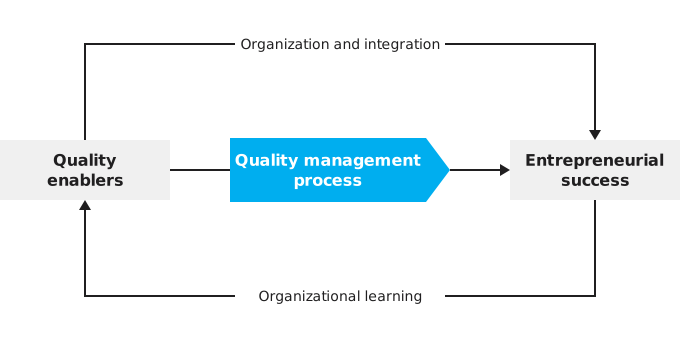
- On the left the quality enablers, on the right entrepreneurial success, between them the quality management process.
- Upper arc: through organization and integration the enablers lead to success.
- Lower arc: through organizational learning, success flows back to the enablers.
- Both arcs form a continuous cycle of improvement.
What the survey says about the EFQM assumptions
The survey of 209 contractors (Method, Results) shows which of the assumptions taken over from the EFQM model are confirmed in this sample. The stronger weighting of leadership is reflected in the data. In the final model, leadership efficiency lies far ahead of the other enablers. For the partnerships that the EFQM model introduced as an innovation, by contrast, no significant effect could be demonstrated. Resource integration, that is knowledge management, electronic systems in the supply chain and the integration of customers, already has no significant influence on communication quality in the initial model (estimate −0.04, p = 0.67) and is no longer included in the final model. The financial value, too, which the QMC model had added to the EFQM model, is not confirmed in the initial model (p = 0.24).
A signal from the search data
The study additionally evaluates the search queries on Google Trends. Interest in the term quality management remained stable over the entire period of evaluation, while interest in ISO 9001, TQM and EFQM declined for all three models. The study reads this as disillusionment with standard models, which are expensive and bureaucratic and depict the workflows of individual companies only roughly. It also sees in this a possible reason why none of the three models is documented in the communication business. An adaptation to the needs of this business was not found in the literature.
The impact-level model as a supplement
Besides the three quality models, the study mentions the impact-level model, which professional associations for controlling and public relations have developed. It arranges the impact of communicative measures in four levels, input, output, outcome and outflow, and is regarded as the standard for communication controlling. It supplements the EFQM model from the perspective of controlling. The thesis does not explore this approach further.

QMC model
Unlike the EFQM, the model measures financial value directly and lists employees only as an enabler.
Method
After the pre-test, 20 of the 26 measurement categories from the literature remained for the questionnaire.
Results
After three amendments, a final model with three enablers and two success parameters remains.
Research question
None of the studies evaluated examined agencies as intermediaries of professional communication.
Leadership
In the final model, leadership efficiency is the strongest enabler, with a standardized weight of 0.98.